Pages

Showing posts with label resume. Show all posts

Wednesday, April 1, 2015

It's April Fool's Day, but don't be a fool forever


I was that person. You know, the one in your classes, who is too scared to ask a question or share an opinion. I was afraid of being wrong or looking stupid. They say with age, comes wisdom, and I'm definitely old enough to know how dumb I was then because I didn't raise my hand when I didn't understand or had a comment to share. The quote in the picture above hangs in my office as reminder to me to ask questions.

On this April Fool's Day, we don't want you to be a fool forever.  Below are 12 typical questions we often receive from students.


What are typical careers for a communication major? (or any other major)
Where can I go to get more information about what environmental engineers do? (or the occupation that interests you)
How can I answer the interview question, "What are your greatest strengths and weaknesses?"
Is this where I take the "test?"


What is the difference between a co-op and internship position?
Where can I find a summer internship in Seattle? (or some other location of interest)
What are other ways I can get experience besides working in an internship?
Does leadership experience count with employers or graduate programs?


What is the best format to use for my resume? (hint: there is not one right answer!)
Where can I get help with practicing for an interview?
What is the timeline to follow for my graduate school applications?
What kind of help do you provide as I apply to medical schools?

Which one of these questions do you want to ask? We have answers for these questions and more! You just need to take that first step and come see us for advising, available at these times and locations.

What questions do you have about your future plans? Career Services advisors can assist you. 

Let us help you reach the next step of the journey to your career.


Wednesday, March 25, 2015

The March Madness of Job Search: Are you ready for your BIG GAME?

NCAA Basketball Tournament season is upon us! Even if you're not a basketball fan, you've probably seen a game or 2 or heard about March Madness. Still in the hunt for a job? We've tied the madness of your search to all the basketball hoopla in the infographic below where you can find resume, cover letter, and interview tips as well as data points from May 2014 graduates found in our annual Post-Graduation Report.

Improve your job search game with tips from this infographic!

Friday, March 6, 2015

Utilize Your Spring Break


If you are not spending your spring break tanning on the beach, you can use this time to dive straight into getting ahead on your job searching. From the comfort of your bed, you can be incredibly productive. Spend your break wisely by following a few of the following suggestions:

· Build and polish your LinkedIn profile: use this time to update all your information, join relevant groups, and network with alumni in a field of your interest. Make sure you have a professional headshot!

· Schedule an informational interview: you can use this time to determine what job would be best for you. Arrange to meet with a professional in your field to gain valuable insight by having questions prepared. Ask them what a typical day on the job is like, what their work environment is like, and about the path they took to get there.

· Try shadowing a professional: contact a professional in your field and request to shadow them for a day. You will be able to see what a day in their shoes is like and if you would enjoy the work they do. It is important to contact them ahead of time to work into their schedule.

· Start researching: while you’re relaxing at home, this is a great time to start compiling research on prospective employers. Create a comprehensive list for companies or employment opportunities that you are considering applying to; include application deadlines, application requirements, salaries, and even a pros and cons list.

· Go over your resume: check to see when the last time your resume has been updated. Ask several different people who don’t know you that well to glance over your resume. It’s important to keep your resume continuously updated and that each version is tailored for every position you apply for.


Wednesday, February 4, 2015

It's February! Show employers some love at career fairs!

When you think of February in the United States, what comes to mind? Candy, hearts and flowers for Valentine's Day? President's Day? Ground Hog Day? One less month of winter? On our campus, February means career fair month.

This year there are seven, yes, 7!, fairs on campus and one fair for sports enthusiasts we've linked to that is occurring elsewhere. The only spring fair sponsored by Career Services, the Connection Job Fair, is for all majors and for students seeking internship, co-op, or full-time positions. Currently, 130 employers are registered to attend. Curious about who is attending? Visit this site to do your research and discover which employers seek your major.

Want to improve your performance at career fairs this month? Try these methods to show some love to employers at fairs you attend.


Present a well written resume to employers. To fine tune your resume, meet with advisors at these various locations and times . Print your resume on finer quality paper containing cotton or linen fibers. Your resume is your ad--make it look good! Have a copy of your unofficial transcript and list of references with you in case an employer asks for them. Carry all of these in a padfolio.


Research employers you want to meet. Create a target list of employers and visit their web sites. A great place to check out is their NEWS. Write down questions you want to ask as you meet with employers. After all, a career fair is a mini interview, where both the employer and you should ask questions. Unsure what to ask? View suggested questions to ask employers .


Practice your introduction. As you walk up to an employer and shake hands, you want your introduction to be polished. The only way for that to happen is for you to work on your introduction. Need help creating your elevator pitch? Visit one a past post to work on your introduction.


Dress for success. What should you wear to a career fair? A suit is fine if you want to look most professional, but business casual attire is appropriate for fairs. Many of the employers you meet will wear more casual attire, so you can too. A nice pair of pants (or skirt or dress for women) and a nice shirt will make a good impression. Leave your 3 inch heels, tight skirt and revealing top at home.


Develop a plan of attack. At the fair, check in, placing your nametag on your right below your shoulder. Obtain a map of employer booths, finding your target employers. Before you speak with an employer, observe. Stand in a long line, listening to the conversation. Move to a few other long lines before you get to the front. Observing gets you more comfortable with how career fairs work. As you speak with employers, save your first choice employer for later to first work on your conversation skills. Ask for business cards!


Bonus! Final tip: Follow up after the fair. Go online if you need to apply. Write employers you meet a thank you note for speaking with you at the fair. Email or call employers a couple of weeks after applying. You will be much more successful in your search for a position if you follow up. And, your follow up demonstrates your interest and initiative.

You've got this! Go spread some Hokie love!!

Monday, December 29, 2014

Be the pilot of your job search: An Infographic

This morning as I was watching CBS This Morning, the anchors were discussing a missing AirAsia plane. An expert from the National Safety Council joined in their discussion. As she spoke, she shared that the pilots of that plane had 3 key jobs:

Aviate
Navigate
Communicate

These same 3 actions can be applied to a journey you may be preparing for, your job search. View our infographic below for tips on how to be the pilot of your job search.

Bon voyage, and let us know if we can help during any stage of your journey.


Thursday, December 19, 2013

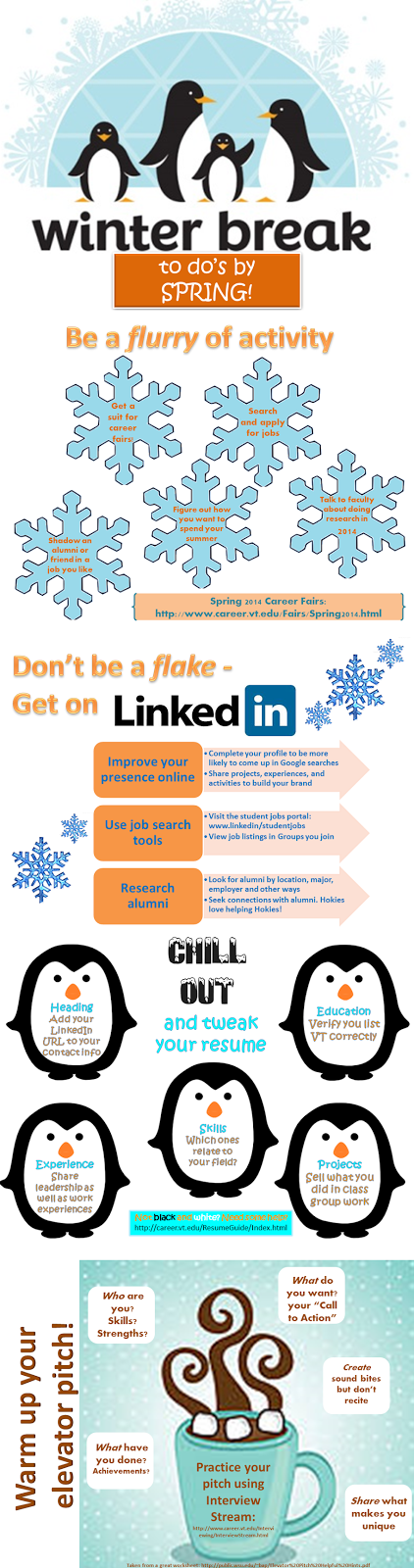
Warm up for Spring 2014: Do these during Winter Break!

Now that finals are behind you, we hope you take some time for yourself to be with friends and family. Have a safe trip to your destination. After you relax, though, prepare for a busy Spring 2014 with these tips:


Monday, September 9, 2013

ROCK your resume! Be ready for career fairs and fall interview season


September is always a busy time for career fairs and the start of the fall interviewing season on our campus. To gear up for these events, it's critical to have your resume ready to hand out to employers. So, how can U ROCK your resume? 


U

se this 4-step formula for your experience descriptions:

Skill: What did you get out of performing this duty?

Structure: Put result into a statement.

Verb: Start with action verbs.

Clarify: Ask yourself who, what, where, when, why, and how many. Using this formula, take your description from “greeted customers” to “developed communication skills by greeting an average of 15 customers per shift.”


R
esults sell! As you describe your work experiences, volunteer positions or projects, be sure to share what you accomplished. Don’t let your resume just read like a job description.


O
rganize your resume sections from most important to least important as you go down the page. For now, list your education section before experience since you are spending most of your time working on your education.


C
ount! Numbers add impact in your resume. If you trained new employees, share that you trained 5 new employees. If you lead the fundraising efforts of your organization, share that you raised $500. Even if you think the numbers are small, they still paint a clearer picture.


K
eep it brief. Rather than sentences or paragraphs, use bullets, list items in columns and write descriptions in phrases. Try to keep to a page if you are an undergraduate. Those with extensive experience or advanced degrees may need to go past one page.

 
If you need help rockin' your resume, come see us in Career Services. For walk-in assistance, visit us Monday through Friday, 12 - 3. On Wednesdays in September, we're extending our walk-in resume help during Resumania where you can stop by 10 a.m. - 5 p.m. without an appointment. If you want some additional help as you prepare for the career fairs and fall recruiting, call 540-231-6241 to make an appointment with a career advisor.

What's your biggest question you still have about your resume that we didn't address above?

Tuesday, July 2, 2013

Your LinkedIn Profile: Resume with a Twist


Why should you be on LinkedIn.com? This site is the destination for you
  • to ensure you have a professional online presence; 85% of employers say that a positive online presence influences their hiring decisions.
  • to network with alumni and colleagues in careers of interest; 70% of jobs are found through networking. LinkedIn is the largest professional network with over 175 million members. And,
  • to use as a tool in your job search. A 2012 Jobvite survey found that 93% of recruiters used LinkedIn as a tool for locating potential hires.
Like Facebook, to get started, you need to populate your Profile. Unlike Facebook, your LinkedIn Profile resembles your resume, with a twist. First, let’s talk about some of the typical parts of your resume to share in Linkedin, then we’ll talk about some twists in LinkedIn.
Your Resume and LinkedIn
For entry level positions, we recommend using an objective on your resume. In LinkedIn, this takes the form of a headline where you mention an area of study, and/or career ambitions. Who are you and what are you looking for? Your headline is the tagline for your personal brand. I really like this headline that was shared in a Forbes article on LinkedIn headlines: “Copywriter who knows how to craft web content that goes viral. Oh, and you’ll never beat me at Scrabble.” After reading the article, I revised my own headline!

In your Profile, also include typical categories of information you find on a resume: Education, Experience, Skills and Expertise, Honors and Awards. If you are just getting started with these, visit this site for more tips on what to include. If you already have a resume, you can upload your resume to start building your Profile.
The Twists

There are several items to add to your LinkedIn Profile that are not typical entry-level resume material:
Photo. No, you don’t want to use that picture of you cheering on the Hokies at the VT-Rutgers Bowl game that you used as your Facebook profile photo. A professional headshot is preferred for your LinkedIn Profile photo.
Summary. Write a summary that describes your skills and experiences.  Talk about skills you’ve gained in the classroom or from internships or soft skills gained from part-time jobs, like communication or time management. If you’ve written a cover letter, pull some of your text from that email for your summary. You can also use your elevator pitch as your summary. Don’t have one? Craft one here.
Recommendations. Although references are part of the job search, they are usually not listed in the resume, but in a separate document. However, in your LinkedIn Profile, you want to ask several people whom you would use as a reference to provide recommendations for you in LinkedIn. These could come from supervisors, professors, or advisors – people who can attest to your performance.

LinkedIn URL: As you are completing your Profile, make sure that you set up your LinkedIn URL as one recognizable with your name. After you create your URL, add this link to your email signature and to the contact information in your resume.
For more tips about getting started with LinkedIn, watch these videos. What questions do you have about your LinkedIn Profile? In our next post, we’ll share advice about networking using LinkedIn.

Monday, March 25, 2013


Time for Spring Break! Here's your To Do List!
1.      Take your resume with you.  You never know whom you might meet while you’re traveling.  Update your resume, or if you don’t have one, then use this time to create one.  For assistance, see the Career Services Career Planning Guide or visit here.
2.  Start looking for an internship or co-op position for the summer.  Here are some places to start looking on-line:
3. Research what you could do with your major after you graduate.  Check out these sites:

4.  Network while you’re having fun!  Someone you meet on Break might be able to help you.  Or, look up some alums on LinkedIn who live where you’re visiting and talk to them:
LinkedIn
Alumni Chapter Contacts all over the world

5.  Research locations you visit during Break. Would you like to live and work there for the summer or after you graduate?

6. Go shopping for an interview suit, so you will be ready for interviews. Need advice about what to buy? Check out this advice about interview attire.

Friday, February 15, 2013

Five Tips to Your Next Career Fair


One of the great opportunities of being a Virginia Tech student is attending career fairs.  Career fairs allow students looking for jobs and internships to meet company representatives in hopes of finding a fit.  Of course, walking into a career fair and looking at the room full of recruiters can be stressful.  As a student myself, my experience at career fairs has led me to follow these five tips:

1) Do your research before you get there.  Career fairs are chock-full of companies, and chances are you’re not going to have the time to visit every booth.  By checking out what companies are going to be there ahead of time, you’ll have a better idea of who you want to talk to, instead of aimlessly walking around.  Plus, if you know what the company does and what you would be interested in before you talk to the representative, you’re innovation might impress them.  Making an impression is the first step for getting your foot in the door.

2) Make sure your resume is ready to go.  Even if you’re not looking to be hired, if you talk to a company at a career fair, they might ask for your resume to have on file.  Now, the actual building of a resume is a long enough topic for its own article, but there are two main things you should keep in mind specifically for a career fair.  First, print more copies than you expect to hand out.  If you plan on talking to five companies, print out eight copies.  If you plan on talking to ten companies, print out twelve.  The last thing you want to happen is engaging in a great conversation with a company representative, only to find that you ran out of resumes when they ask you for one.  Second, be smart about what paper you choose to print your resume on.  Heavier paper looks more professional that regular printer paper.  If you want to choose a color, a light cream or light blue can be used.  However, most companies I’ve talked to say they prefer white.  In the end, it’s nice to stand out, but you want to be remembered for what is on the resume, not what the resume is on.

3) Practice your elevator speech.  An elevator speech is a thirty second introduction about yourself to prospective employers. Let’s face it: talking to someone who might hire you in the future can be intimidating.  Saying hello and introducing yourself can be the scariest part.  However, if you practice your elevator speech enough, it will become so natural to you, you won’t even have to think about what you’re saying.  Then when the scary introduction is over, the employer can start to add to the conversation and you can take a quick breather before continuing on.  First impressions are important, so make yours count. 

4)  Dress for the job you want to have, not the one you currently have.  The title says it all.  Dressing casually can make you look like you don’t care, an impression you do not want to give a prospective employer.  However, go overboard, and you might risk tripping in those new heels you just bought.  Dressing up is supposed to be about confidence, so find that outfit that brings out your inner confidence and show those companies what you’re made of. 

5) Don’t talk to your number one company right away.  Walking into the career fair, you probably already have an idea of at least a few companies you want to talk to.  Maybe these are big and well-established companies that have been around for ages, or maybe you’re passionate about joining a start-up company.  Regardless, you might find yourself tensing up when you finally come face to face with the recruiter from that company.  To help battle the nerves building up in you, try talking to other interesting companies that might not be as high on your priority list first.  If you start with companies you’re not as interested in, you get the chance to make all of your mistakes and figure out what and what not to do before you get to your top company.  That way, when the time comes, you’ve already had some practice.

So if you attend any of next week’s career fairs, take a deep breath, follow these tips, and remember: these recruiters want to talk to you.  That’s what they’re there for.  So feel free to ask questions and take all the free swag they hand out to you.